
An AI assistant for your sales team's technical questions
The problem, in practice
A salesperson waiting for a product expert's answer before responding to a prospect loses time, and sometimes the opportunity itself. When that expert is a single person, or a small team, this bottleneck repeats every week, on questions that have often already been answered elsewhere in the internal documentation.
81% of companies investing in AI choose a custom-built solution or a purpose-built development rather than a standard tool (Bpifrance, Baromètre IA 2026). An internal technical assistant is a typical case where the documentation, business vocabulary and products are too specific for a generic tool to answer correctly.
What the tool does, in practice
A custom-built tool designed for this case draws on your existing internal technical documentation (product sheets, specifications, answers already given) to answer your sales team's questions in natural language, with a link back to the source document for verification.
The achievable level of coverage, the structuring required for your existing documentation and the share of human review before an answer is passed on to an end client are not decided in advance: these points are precisely the purpose of the audit.
How we work
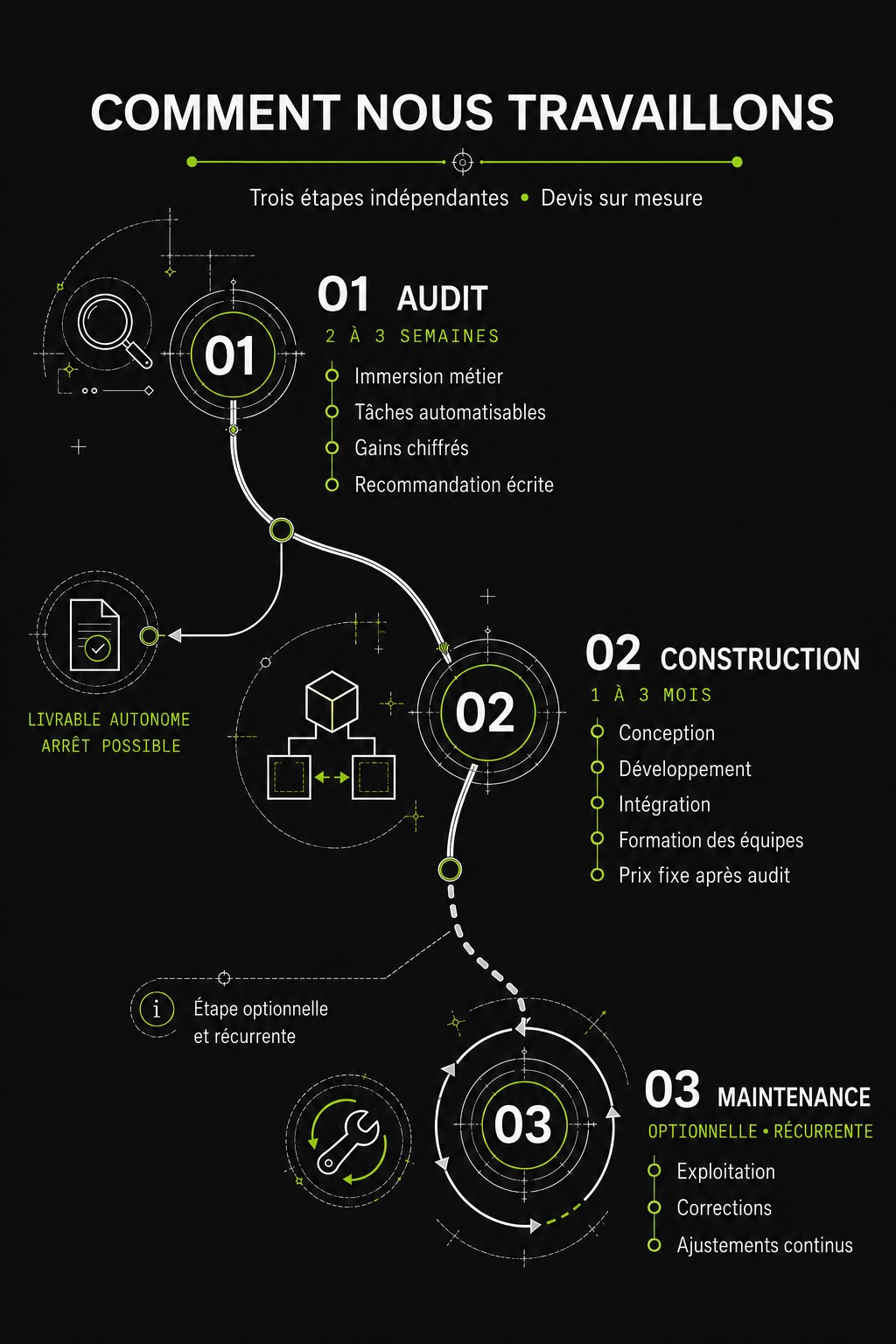
Three steps, each independent: you can stop after the audit.
Immersion in your technical documentation and current sales processes, costing of the expected gain, written recommendation.
Design, development, integration with your existing sales tools, then training for your teams.
We adjust the tool as your documentation and your offering evolve.
Frequently asked questions
Can the assistant get an important technical question wrong?
The level of human validation and the systematic link back to the source documentation, for the most sensitive questions, is one of the choices arbitrated during the audit, as with every Sundatalab custom-built tool. This is not a generic guarantee, but an arbitration specific to your business and your risk tolerance.
Does the technical documentation need to already be perfect for the tool to work?
No, but the actual state of your documentation (up to date, scattered, incomplete) is precisely one of the points examined during the audit: it determines what the tool can cover from the start and what needs to be structured beforehand.
How long does it take to set up such an assistant?
The general timeline for Sundatalab custom-built projects is a 2 to 3 week audit, followed by a 1 to 3 month build. The exact duration depends on the volume of documentation to cover and its current structure.
Does this assistant replace our technical team or our sales team?
No, it takes over a repetitive and time-consuming task (answering recurring technical questions) to free up your teams, not to replace them. This is the same logic behind all of Sundatalab's custom-built work.
What happens when our catalog or documentation changes?
That's the role of optional maintenance: we adjust the tool as your documentation and offering evolve, without starting a new project each time.
See other Studio use cases
Product sheets for a catalog of thousands of items
Generating and maintaining consistent product sheets for a catalog too large to write by hand.
Read the use case →Automated client reports
Automatically turning raw operational data into readable reports, ready to send to your clients.
Read the use case →Adapting a sales document for 30 markets
Adapting the language, units and cultural references of the same sales material to a large number of markets, without losing weeks on every adaptation.
Read the use case →Start with an audit
We look at your sales processes and technical documentation, we estimate what this assistant would bring, and we tell you whether to build it, or not.

Sundatalab designs and runs artificial intelligence tools that help businesses grow. Ours, by license. Yours, custom-built.