
Automating product sheets for a catalog of thousands of items
The problem, in practice
A catalog of several thousand items cannot be written sheet by sheet by hand without dedicating an entire team to it, continuously. The result, when this task is understaffed, is well known: incomplete sheets, an inconsistent tone from one item to the next, and a permanent backlog every time a new product arrives.
81% of companies investing in AI choose a custom-built solution or a purpose-built development rather than a standard tool (Bpifrance, Baromètre IA 2026). A large catalog is precisely the type of case where a standard tool, designed for the average business, does not fit the actual data structure of one particular company.
What the tool does, in practice
A custom-built tool designed for this case takes the structure of your existing catalog (product master data, technical specifications, visuals) and derives a sheet consistent with your brand's tone and vocabulary, item by item.
The exact specifics (available source data, achievable level of automation, integration with your product management tool, share of human review before publishing) are not decided in advance: this is precisely the purpose of the audit, once your catalog and tools have actually been examined.
How we work
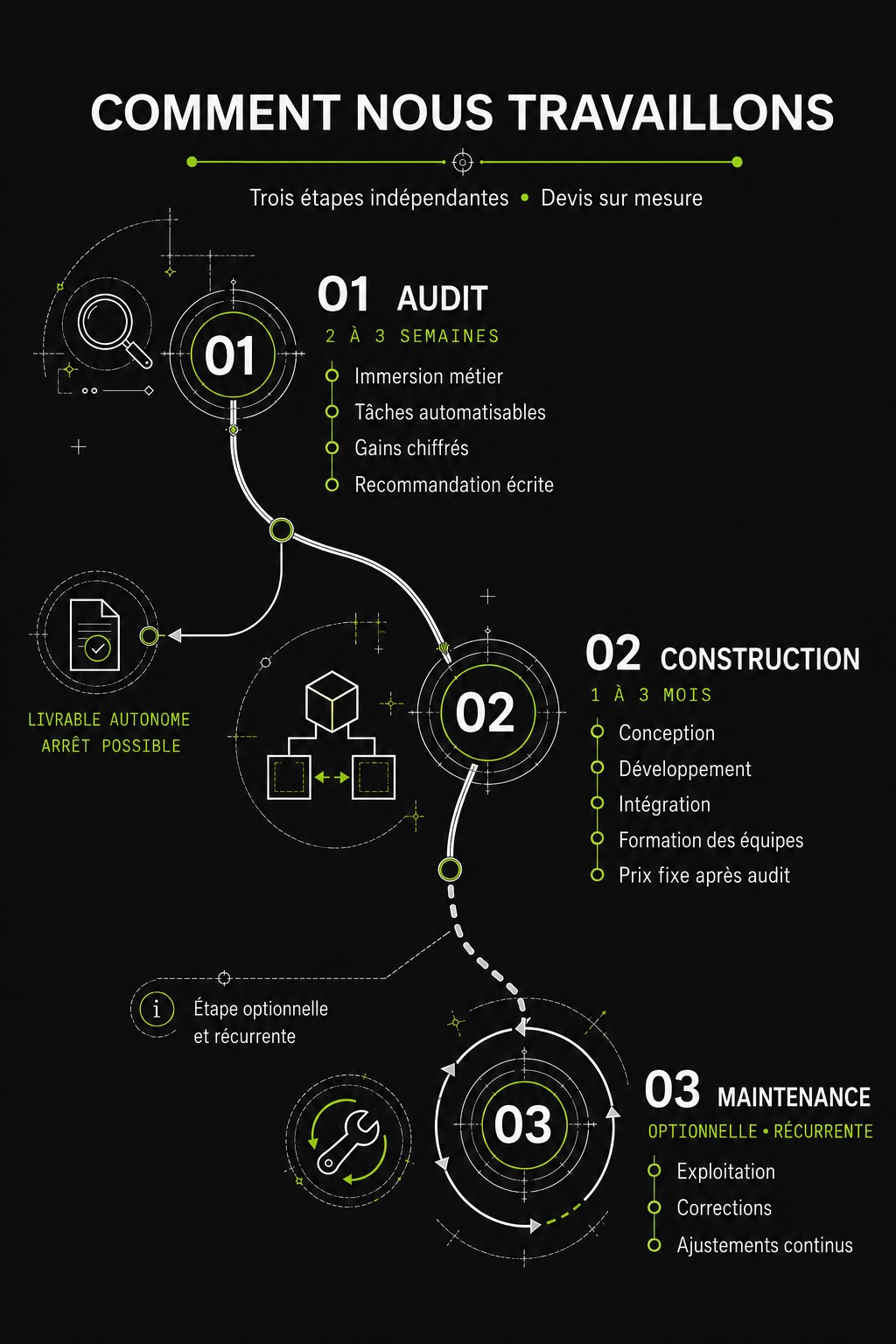
Three steps, each independent: you can stop after the audit.
Immersion in your catalog and current tools, costing of the expected gain, written recommendation. Useful even if you don't build anything afterward.
Design, development, integration with your existing product management tool, then training for your teams.
We adjust the tool as your catalog evolves, without starting a new project each time.
Frequently asked questions
How long does setup take for a catalog of several thousand items?
The general timeline for Sundatalab custom-built projects is a 2 to 3 week audit, followed by a 1 to 3 month build. The exact duration for a large catalog depends on the number of items, the quality of the source data and the level of automation targeted: these points are clarified during the audit, not before.
Does the price depend on the number of items in the catalog?
The audit is priced between €3,000 and €8,000, the build between €20,000 and €80,000 depending on the project. The volume of the catalog is one of the factors that moves this amount within that range; the precise quote is established after the audit, not before.
Do we keep human review over the generated sheets before publication?
The level of human review before publishing (systematic validation, sample-based review, or full automation for the largest catalogs) is one of the choices arbitrated with you during the audit, based on your risk tolerance and the volume to process.
Does this tool replace our current team?
No, it takes over a repetitive and time-consuming task to free up your team, not to replace it. This is the same logic behind all of Sundatalab's custom-built work: a tool that fits your business, without requiring you to hire to get it.
What happens if the catalog keeps growing after delivery?
That's the role of optional maintenance: we adjust the tool as your catalog evolves, without starting a new project each time.
See other Studio use cases
Technical assistant for your sales team
Answering, in seconds, the technical questions your sales team asks repeatedly, drawing on your internal documentation.
Read the use case →Automated client reports
Automatically turning raw operational data into readable reports, ready to send to your clients.
Read the use case →Adapting a sales document for 30 markets
Adapting the language, units and cultural references of the same sales material to a large number of markets, without losing weeks on every adaptation.
Read the use case →Start with an audit
We look at your catalog, we estimate what automating product sheets would bring, and we tell you whether to build it, or not.

Sundatalab designs and runs artificial intelligence tools that help businesses grow. Ours, by license. Yours, custom-built.