
Know what you're allowed to do, before you invest.

The regulatory timeline
The European AI Act is being rolled out in successive phases. Two deadlines already concern every company.
Mandatory AI training for staff, and a ban on certain practices considered an unacceptable risk.
A new set of obligations applies, notably on the transparency of AI systems and their classification by risk level.
This timeline may change; we track official updates and adjust our recommendations accordingly. It does not replace personalized legal advice for your situation.
What we offer
- Inventory of all your AI systems, including undeclared uses
- Classification by risk level
- Ready-to-use compliance register
- Prioritized action plan
- Ongoing updates to the register
- Alerts on new obligations
- Answers to your everyday questions
- Quarterly review
- Identification of priority use cases
- Buy-versus-build decisions
- Sequencing of your AI projects
What this changes for you
Peace of mind
You know precisely what you're allowed to do, without having to think about it every time you launch a new project.
Unblocked projects
Legal uncertainty freezes initiatives that, once clarified, can start without risk, often faster than expected.
Sanctions avoided
Up to 35 M€ or 7 % of global revenue: an up-to-date register is what protects you before an audit becomes a problem.
Stronger credibility
Being able to present a compliance register to a demanding client or partner becomes an advantage, not a constraint.
Often, the best place to start
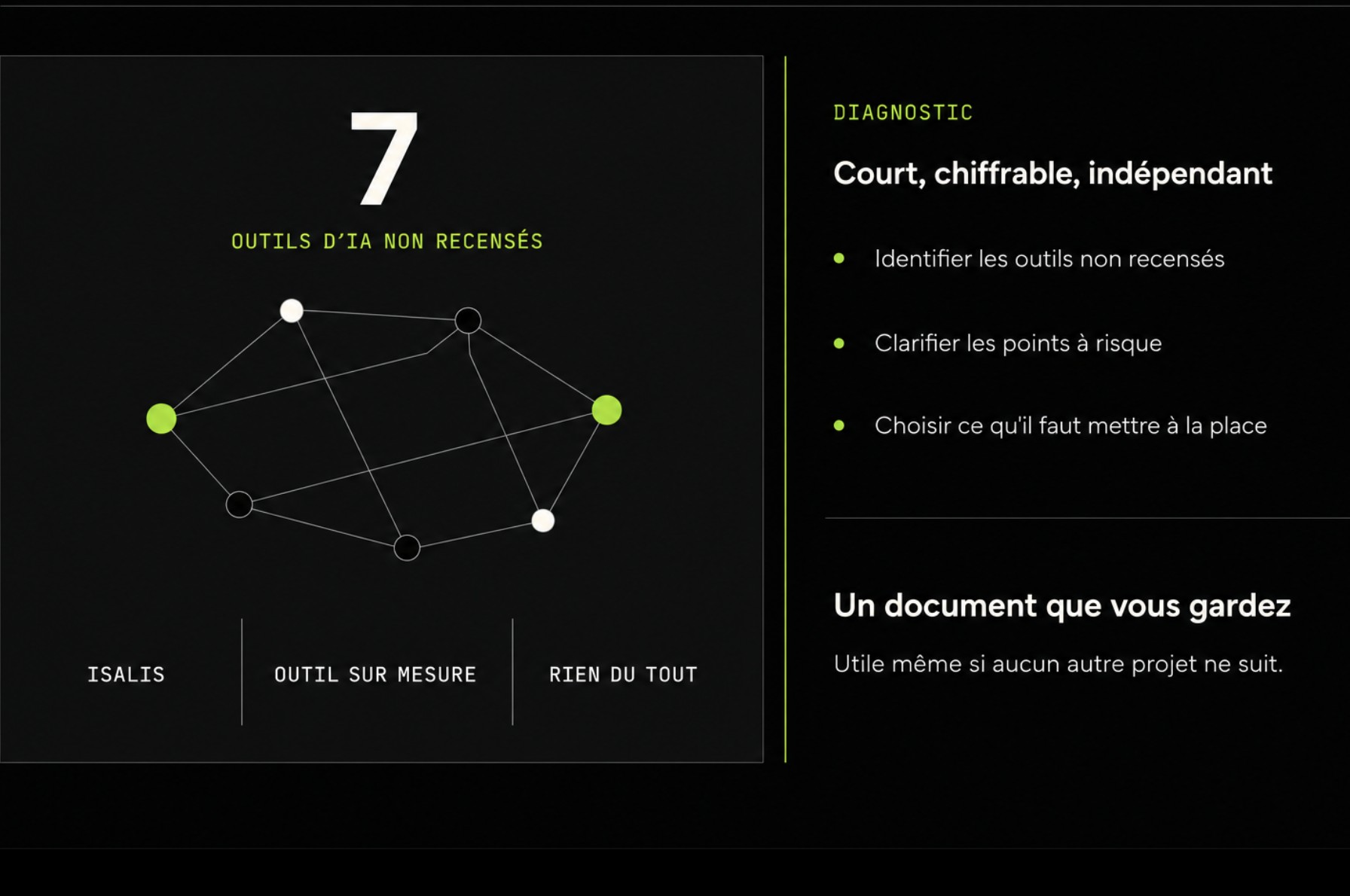
The compliance diagnostic is short, measurable, and addresses a real concern. A company that discovers seven undeclared AI tools, several of them problematic, can then have a natural conversation about what should replace them: whether that's Isalis, a custom-built tool, or nothing at all.
The diagnostic commits you to nothing else: it's a document you keep, useful even if it doesn't lead to any other project with us.
Frequently asked questions
Does the diagnostic cover tools my teams use without having told management?
Yes, that's precisely one of the objectives: to identify actual usage, including tools that were never formally approved.
Are we required to continue with monitoring after the diagnostic?
No. The diagnostic is a standalone service billed separately; monitoring and strategic guidance are independent options that you can activate if you wish.
Does this service replace legal advice?
No. We help you map out your usage and understand your operational obligations; for any complex legal question, we recommend consulting a specialized lawyer.
Find out where you stand, no strings attached
An initial conversation to understand your situation and tell you whether a full diagnostic is needed.

Sundatalab designs and runs artificial intelligence tools that help businesses grow. Ours, by license. Yours, custom-built.